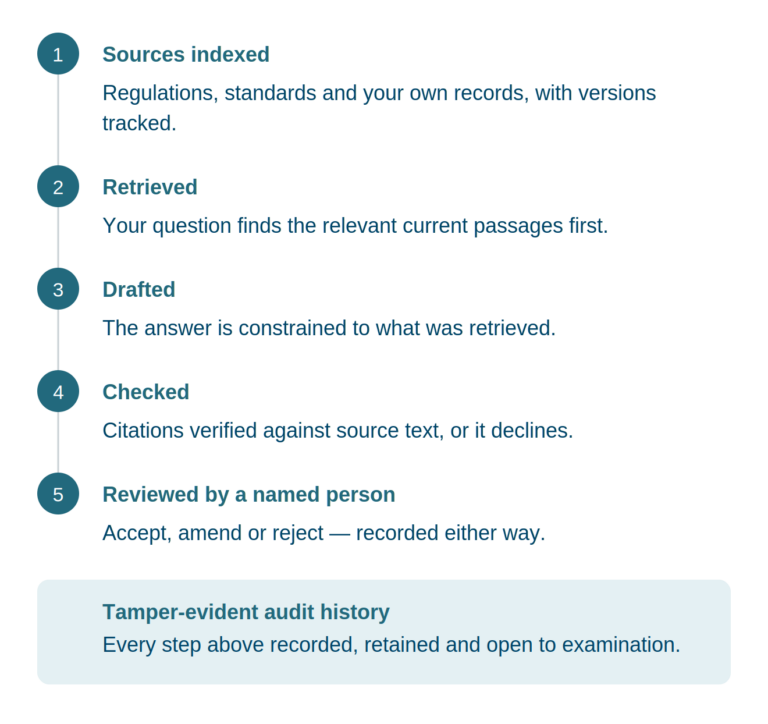



A general-purpose AI assistant answers from what it absorbed in training. Our engine does the opposite: it retrieves the relevant passages from current, authoritative sources first, then works only from those — so every answer can be traced back to the text it came from.
The relevant regulation, national standard or assessment-judgment descriptor — with the passage shown, the version in force identified, and an explicit answer where the sources overlap. The practical use is helping a team frame the right questions rather than answering them.
Stays with your team.
Applying the standard to the circumstance in front of you, the part that takes professional judgment.
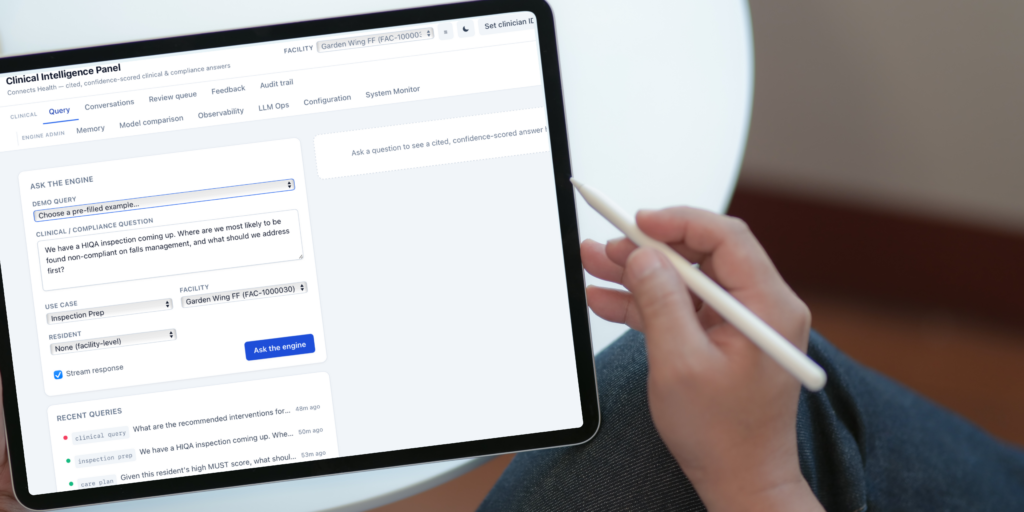
The same retrieval turned on the service’s own records in connects.health — assessments, care plans, incidents and audits — so a question about what has been recorded, and when, is answered with the entries themselves attached rather than reconstructed by hand.
Stays with your team.
What the answer means, whether it warrants action, and what happens next.
The difference is preparation time. Questions that took an afternoon of cross-checking folders and spreadsheets
are put together from the records you are already keeping,
with the entries behind each answer openable line by line.
You know what good care looks like. Showing it is the part that costs a week — pulling records together, checking they agree, and being ready for the question before it is asked. That work is shared across a service, and it looks different from each desk.
The questions land here first, and the answer has to hold. Whether the service is one you have run for years or one you started in last month, what was found, what was committed to and what is overdue can be asked for directly rather than reconstructed.
Preparing the pack, tracking actions to closure, and finding the gap in your own records before anyone else does — the difference between an audit system judged effective and one judged absent.
Assurance across several services without waiting on each one to compile its own returns, in its own format, at its own pace. The same question, asked once, answered consistently.
The evidence is a by-product of the recording already being done, not a second act of recording on top of it. Anything that asks for the same information twice has failed.
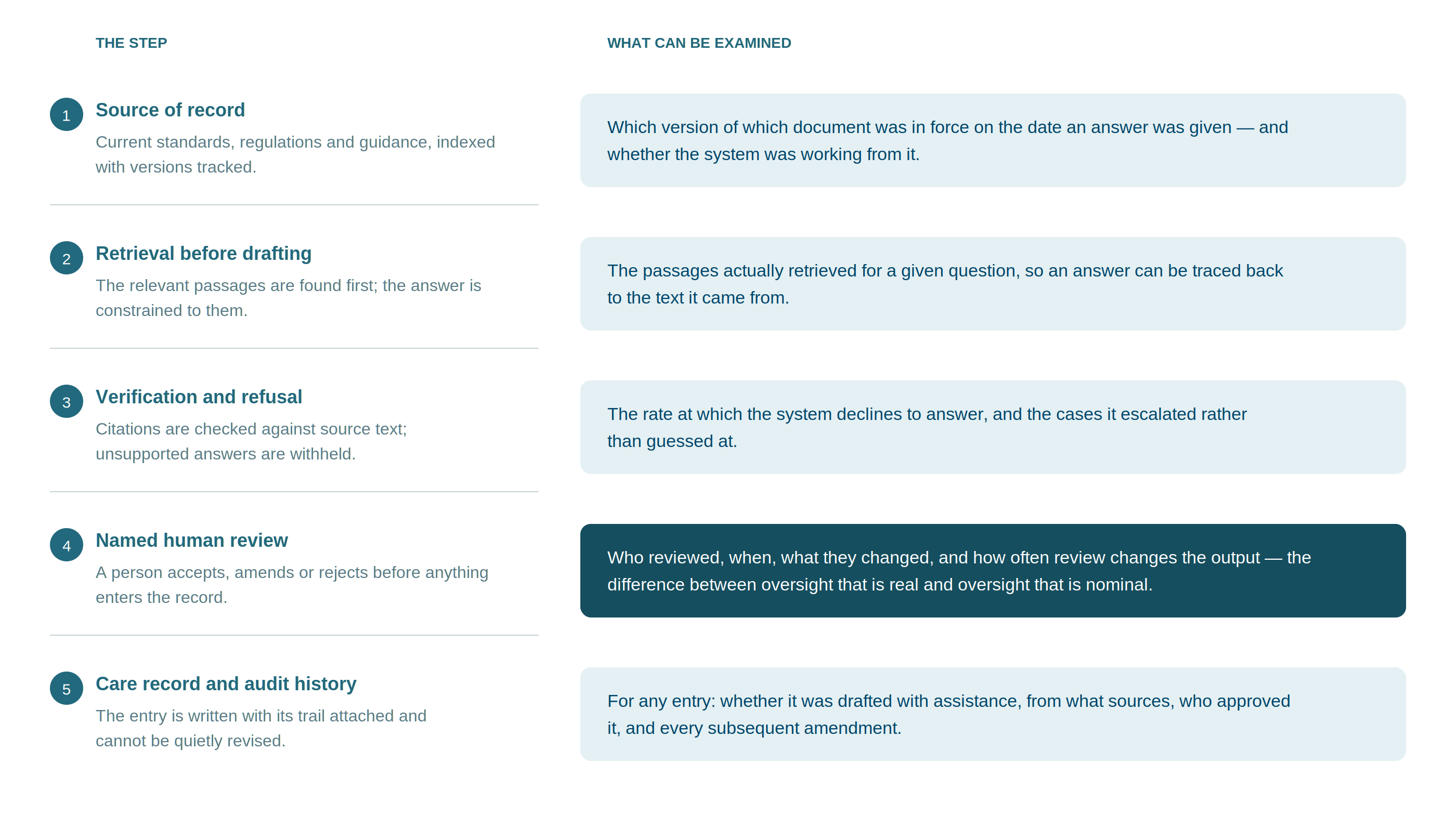
What an inspector could examine at each step.
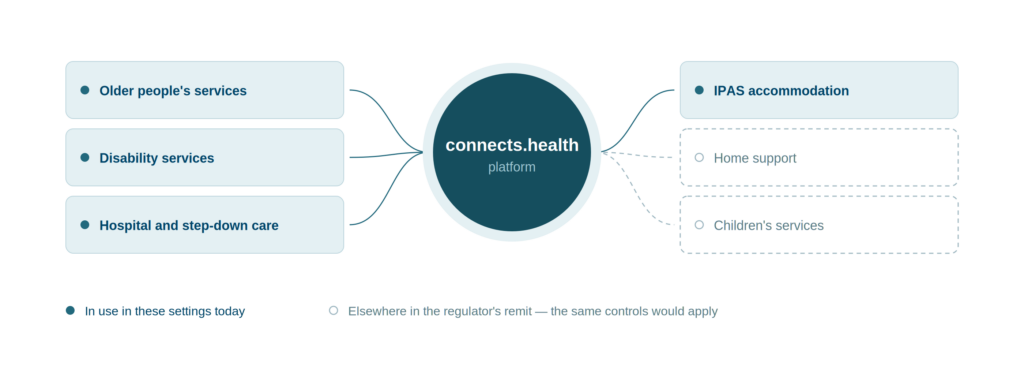
Regulated care spans settings that differ considerably in law, population, harms and workflow. The assurance question does not change between them: can a record be traced to what actually happened, and can the review behind it be shown? The controls are common. That is not the same as saying the system is identical everywhere.
The Clinical Intelligence Engine is a layer inside a platform that already carries assessments, care planning, incident management and regulatory reporting in services that are inspected against national standards.